See the path from where you are now to the career you want.
TrajectoryAI turns your current grade, education, or work experience into a step by step career map. See what to learn, which credentials matter, the jobs along the way, how long each stage takes, what it pays, and the alternate routes that stay open. Every published figure links back to a federal source you can open and check.
“How can I become an Astronaut at NASA from where I AM today?”
Ask like a person.
Get a route back.
Tell it where you are and where you want to end up. TrajectoryAI works out your starting point, draws the route between the two, and prices every step from a public federal table. Not a chatbot with opinions about your future. A map with sources on it.
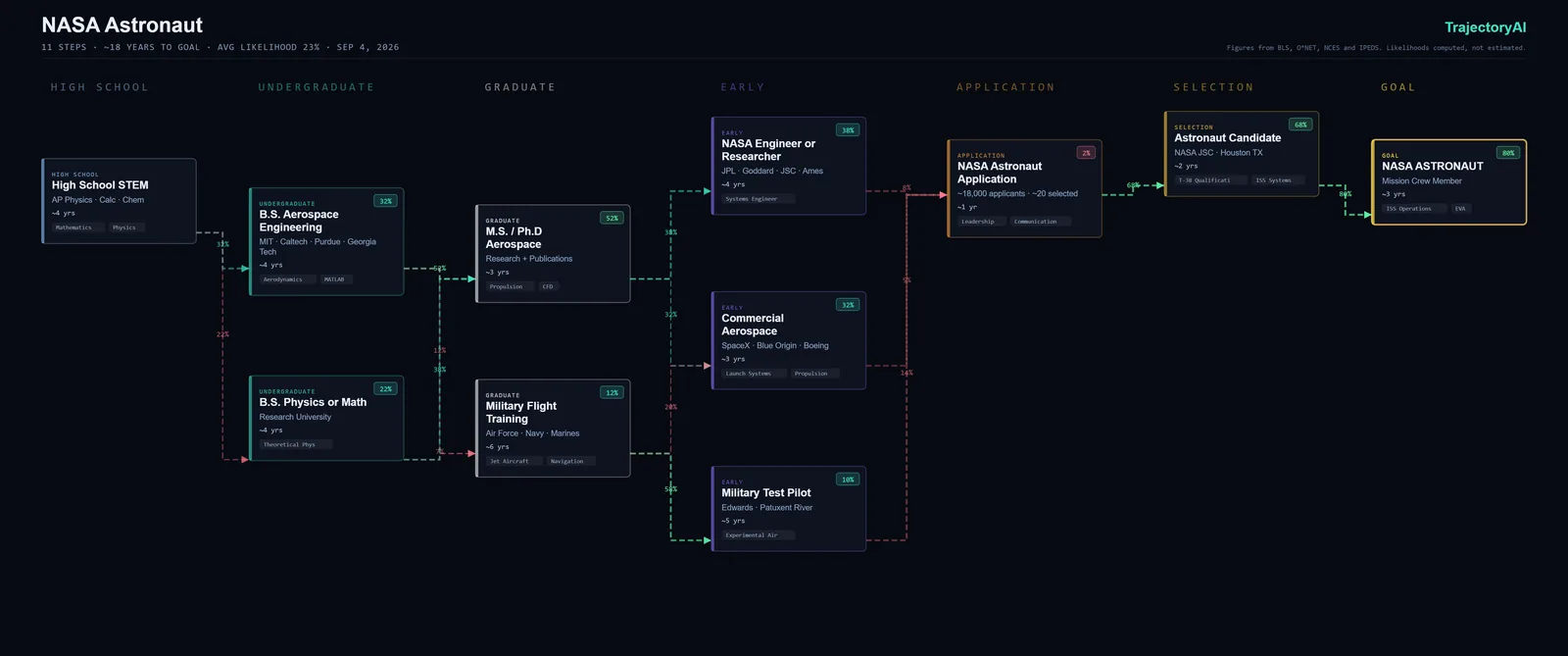
11 steps, about 18 years, and a likelihood on every one. It starts with high school STEM.
Not an opinion. A route with distances on it.
Every map is built the same way, so you can always tell which parts came from a public table and which parts the model wrote.
Starts from where you actually are: a grade, a transcript, or a résumé.
Draws the whole route, including the branches that stay open, not just the goal.
Prices every step from a federal table, keyed to an occupation code and stamped with its vintage.
Puts a likelihood on every step and every transition. Computed, not estimated.
Reads news and hiring trends for each occupation and flags how stable the job looks.
Leaves a blank where the data stops, and says so.
From question to map
The builder does not improvise a version of your future. It follows the same six steps every time, and you can see each one on the finished map.
-
Step 01
Find your starting point
A sentence like "I'm in 8th grade," a pasted transcript, or an uploaded résumé. The map works out where you stand today. Uploads are read for that and aren't kept.
-
Step 02
Draw the route
The model lays out the stages between here and the goal: the courses, credentials, exams, and jobs in between, and the branches that stay open if plans change.
-
Step 03
Price every step
Each wage, growth figure, and completion rate is looked up in a public federal table, keyed to an occupation code, and stamped with its vintage. Click any figure to open the table it came from.
-
Step 04
Score every step
Every step and every transition carries a likelihood, computed from federal data rather than estimated. It tells you how often, not whether. The astronaut map above averages 23 percent across its route.
-
Step 05
Check how stable the job is
For each occupation on the route, the builder reads news and hiring trends and flags how stable the job looks, so a growing field and a shrinking one never read the same.
-
Step 06
Leave the gaps visible
Where no table exists, the field reads unavailable and names the step. That is why the astronaut map above carries no wage for its goal.
Join the beta and tell us where you are now. We'll map what comes next.
Every number comes with the source. If we can't verify it, we leave it blank.
Every part of a map carries a tag saying what kind of thing it is. Data is a figure from a public federal table, with its vintage and a link. AI is text the model wrote, including how long it thinks each stage takes. That is the one estimate it's allowed. Computed is arithmetic over the two. You never have to guess which one you're looking at.
Know what to do next, what it will take, and which other paths stay open.
-
Know your next step before you focus on the end goal
See the courses, credentials, exams, and intermediate jobs in order, with the prerequisites for each one so you know what to act on next.
-
See backup routes before you need them
Career plans change. The map shows adjacent roles and alternate routes your training can lead to, so one change does not make the work you already did feel wasted.
-
Compare pay and opportunity where you live
Switch from national figures to state data where available, so the decision reflects the market you may actually enter rather than a generic national average.
-
Compare careers without opening ten tabs
Put two or three careers on the same scorecard and compare pay, growth, education, time to entry, typical costs, and daily work in one view.
Join the beta now, or keep scrolling to see how TrajectoryAI fits students, parents, and counselors.
Start from the decision you are trying to make right now.
I know what I want. I don't know what comes first.
You have a goal and a blank space between here and there. A map fills in the space with real steps, in order, starting from the grade you're in now.
Map my goal →I want to help without guessing.
Advice about careers ages badly. See what the path costs, what it pays, and how long it takes using the same data the government publishes.
See a sample map →I need something I can defend to a family.
Every figure carries its source and vintage. Bring a map into a meeting and click through to the table it came from.
Request a pilot →Career advice needs judgment. Career decisions also need numbers you can verify.
It answers in three seconds and sounds certain doing it.
A language model produces numbers the same way it produces sentences: by predicting what ought to come next. Sometimes that lands on the real figure. Nothing in the answer tells you which times it did.
Good for talking the idea through, drafting, and naming options you didn't know existed.
A person who reads you, not your inputs.
They hold you accountable, know your school, and catch what no dataset records. They're also rationed. ASCA recommends 250 students per counselor; the national average is 372 to 1, and 571 to 694 in elementary and middle schools. That is where an 8th grader asking about astronauts actually sits.
Good for judgment, encouragement, and every part of this that isn't a data problem.
A model draws the route. It is never allowed to price it.
Structure comes from a language model. This is the part it's genuinely good at. Every figure is then looked up against a federal table, keyed to an occupation code, and stamped with its vintage. What can't be retrieved renders as missing rather than as a guess, so you always know which parts are grounded.
Not a replacement for a counselor. Something to walk in and put in front of one.
The things people ask
before they sign up.
What does it cost?
Where do the numbers actually come from?
What if there's no data for my goal?
How current is the data?
What do I need to give it?
Is this only for students?
How old do you have to be?
What happens to my email?
Start with where you are.
We'll map what comes next.
Join the beta and answer two short questions about where you are now and where you want to go. We are opening in small groups while we expand career and data coverage.
Free while in beta · No card
See the NASA astronaut example
Questions → omozusi.e.guobadia@gmail.com